
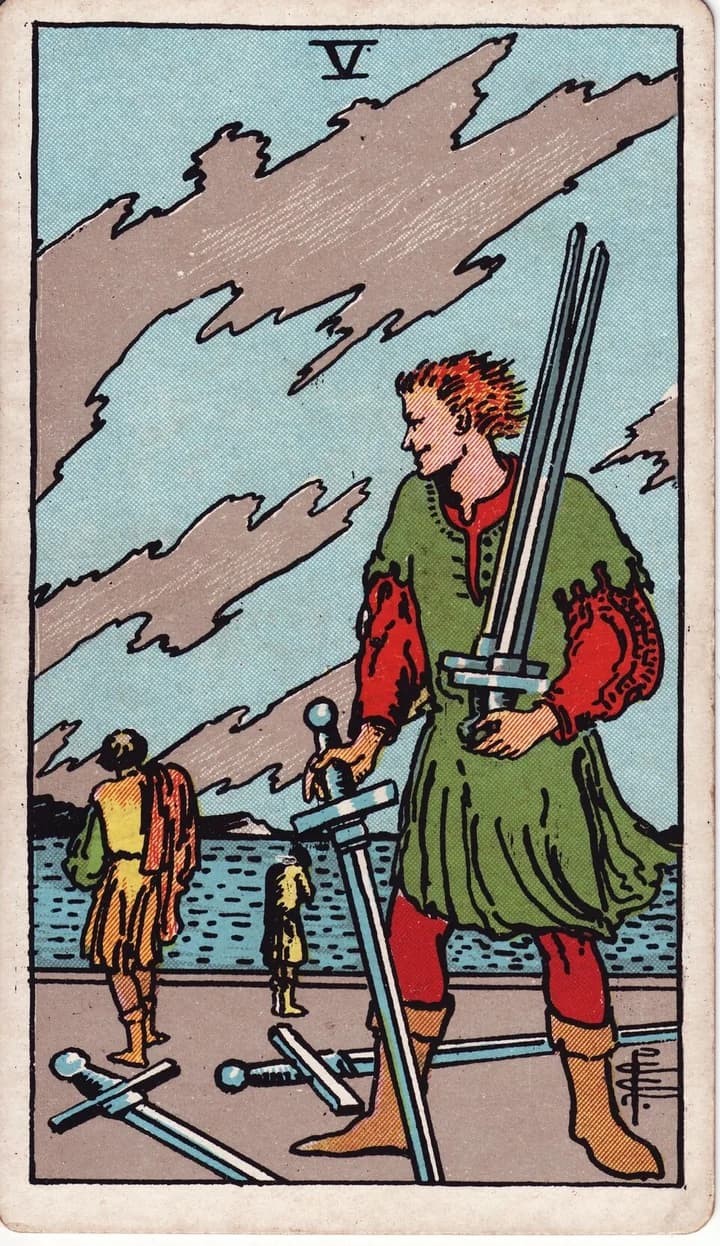
Positive Aspects vs. Challenges
Recognizing the cost of victory becomes useful when it creates movement, honesty, or a clearer choice.
Humiliation becomes difficult when it turns rigid, avoidant, or disconnected from reality.
Leaving a hostile field becomes useful when it creates movement, honesty, or a clearer choice.
Empty win becomes difficult when it turns rigid, avoidant, or disconnected from reality.
Learning from the aftermath becomes useful when it creates movement, honesty, or a clearer choice.
Escalating the fight becomes difficult when it turns rigid, avoidant, or disconnected from reality.
Positive Aspects
Meaning 1. Recognizing The Cost Of Victory
A win that doesn't quite feel like one. When Recognizing the cost of victory is central, Five of Swords points to the part of the situation that is ready to be named and worked with directly.
- Notice where Recognizing the cost of victory is already visible in the question.
- Look for the smallest concrete action the card supports.
- Read the card as a pattern in motion, not a fixed prediction.
Meaning 2. Leaving A Hostile Field
Five of Swords favors honesty about whether the fight was worth winning, and whether the cost matched the prize. When Leaving a hostile field is central, Five of Swords points to the part of the situation that is ready to be named and worked with directly.
- Notice where Leaving a hostile field is already visible in the question.
- Look for the smallest concrete action the card supports.
- Read the card as a pattern in motion, not a fixed prediction.
Meaning 3. Learning From The Aftermath
A win that doesn't quite feel like one. Five of Swords favors honesty about whether the fight was worth winning, and whether the cost matched the prize. When Learning from the aftermath is central, Five of Swords points to the part of the situation that is ready to be named and worked with directly.
- Notice where Learning from the aftermath is already visible in the question.
- Look for the smallest concrete action the card supports.
- Read the card as a pattern in motion, not a fixed prediction.
Challenges
Meaning 1. Too much Humiliation
Letting go of the grudge, walking back, or recognising you've been the one with the swords. As a challenge, Five of Swords asks whether Humiliation is being expressed cleanly or pushed too far.
- Humiliation may become exaggerated or one-sided.
- The situation may need more context before action.
- A helpful signal can become a problem if it ignores timing, consent, or limits.
Meaning 2. Empty win
Time to set them down. As a challenge, Five of Swords often asks what has been delayed, denied, overdone, or misread.
- Check whether Empty win is blocked or being forced.
- Separate fear from useful caution.
- Ask what practical repair would make the message healthier.
Meaning 3. Escalating the fight
Five of Swords should not be reduced to a single keyword. If Escalating the fight appears important, test it against the question, the surrounding cards, and the real-world constraints.
- Do not assume Escalating the fight is automatically positive or negative.
- Compare the card position with the querent’s actual choices.
- Use the card to clarify responsibility, not to replace judgment.
Love, career, finances & advice
Love & Relationships
In love readings, Five of Swords shows how Recognizing the cost of victory moves through attraction, trust, communication, and timing.
- New connection: Recognizing the cost of victory may describe the first emotional signal.
- Established relationship: Recognizing the cost of victory shows what needs attention or renewal.
- Reconciliation: compare the desire to return with evidence of changed behavior.
Personality & Feelings
As a person or feeling, Five of Swords can describe someone who expresses Leaving a hostile field clearly, or someone learning how to handle that quality.
- Positive: Leaving a hostile field can be attractive, sincere, or growth-oriented.
- Shadow: the same trait can become immature, defensive, or inconsistent.
- Feelings: read the card as mood plus capacity, not mood alone.
Career
For work, Five of Swords points to where Learning from the aftermath affects decisions, collaboration, momentum, and long-term results.
- Useful when Learning from the aftermath supports a clearer next step.
- Watch for missing structure, skill gaps, or avoidable delay.
- Translate the card into one action, one conversation, or one boundary.
Finances
Financially, Five of Swords asks how Leaving a hostile field is shaping spending, saving, risk, and security.
- Upside: Leaving a hostile field may open a better use of resources.
- Risk: impulse, fear, or avoidance can distort money choices.
- Advice: pause before major commitments and check the numbers.
Advice from Five of Swords
Meaning 1. Use the card actively
Five of Swords advises you to work with Recognizing the cost of victory deliberately. Choose one action that makes the card practical instead of abstract.
- Name the real issue behind Recognizing the cost of victory.
- Choose one next step that can be done today.
Meaning 2. Balance the shadow
Letting go of the grudge, walking back, or recognising you've been the one with the swords. Let Five of Swords be a mirror for both the promise and the risk of the situation.
- Keep the useful side of Leaving a hostile field.
- Add structure, honesty, or patience where the card feels unstable.
References
Built from the Rider-Waite-Smith tradition, the Oniro deck manifest, and the card notes maintained in this project.